
A returned check is one the writer’s bank sends back unpaid, and your bank charges the amount back to your account. Recovering it is up to you: check the reason, contact the right person, decide whether to redeposit, and collect any fee your state allows. This guide covers the timeline, the recovery steps, returned check fees, and when electronic re-presentment is an option.
In 2025, the Federal Reserve handled about 22 million returned commercial checks worth $78 billion (Federal Reserve).
What Happens When a Returned Check Comes Back?
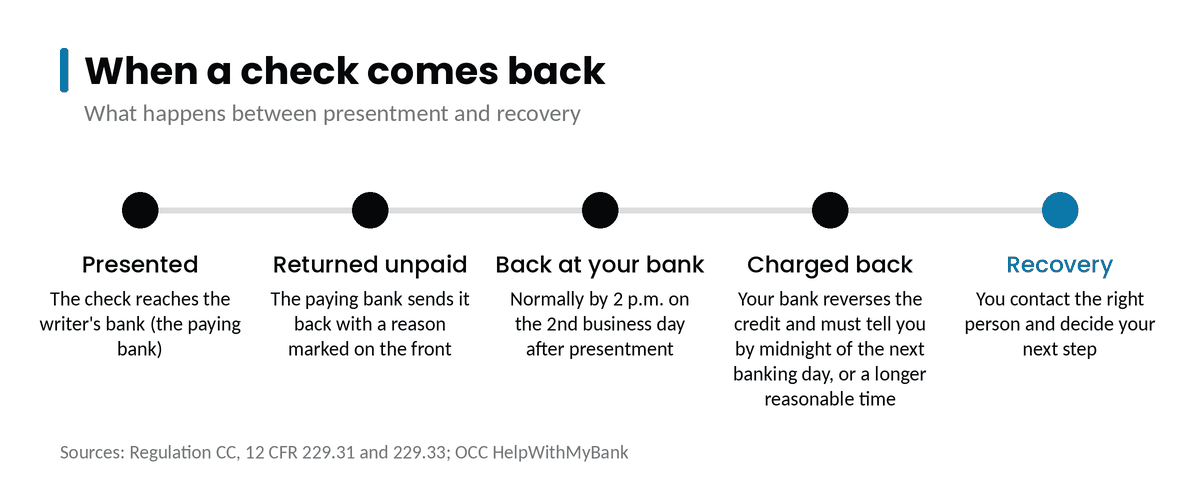
The paying bank, which holds the check writer’s account, must return an unpaid check quickly. Under Regulation CC, the return should normally reach your bank by 2 p.m. on the second business day after the check was presented (12 CFR 229.31). For a check of $5,000 or more, the paying bank must also send a notice of nonpayment on the same timeline.
When the return arrives, your bank can reverse the credit and may charge you a fee. As the payee, you must then pursue the check writer (OCC).
Your bank must tell you by midnight of the banking day after it receives the return, or within a longer reasonable time (12 CFR 229.33). The reason for return is marked on the front of the returned check.
Why Do Checks Come Back?
The return reason tells you what to do next. Banks use return reasons from an industry standard for check images. These are some you may see.
| Return reason | What it usually means | Next step |
|---|---|---|
| Insufficient or uncollected funds | The account was short when the check was presented | Contact the writer; redeposit or re-present when funds are likely there |
| Stop payment | The writer told the bank not to pay | Contact the writer; don’t redeposit |
| Closed account | The account can’t pay any checks | Collect another way |
| Refer to maker | The bank gives no detail | Contact the writer |
| Altered, counterfeit, or irregular signature or endorsement | The check may be fraudulent | Don’t redeposit; follow your fraud steps |
Regulation CC’s official commentary says “refer to maker” is the wrong reason for an altered or unauthorized check. If a check comes back that way and something looks off, treat it as possible fraud.
How Do You Recover a Returned Check?
Work through the same steps every time, and keep a record of each one.
- Read the reason and pull the image. Compare the returned item with your copy, and check the endorsement and amount.
- Contact the right person quickly. A business usually contacts the check writer. A check casher may contact the customer who cashed the check as well as the writer, depending on state law and its own policy.
- Decide whether to redeposit. No federal law limits how many times a paper check can be resubmitted; your bank sets that policy (OCC). Your bank may also hold a redeposited returned check longer than usual (12 CFR 229.13).
- Consider electronic re-presentment if the check came back for insufficient or uncollected funds and qualifies (see below).
- Send a written demand if the writer doesn’t pay. Many states set the notice you must send and the fees you can claim.
- Close the file. Record what you collected, write off what you can’t, and note the customer or writer for future checks.
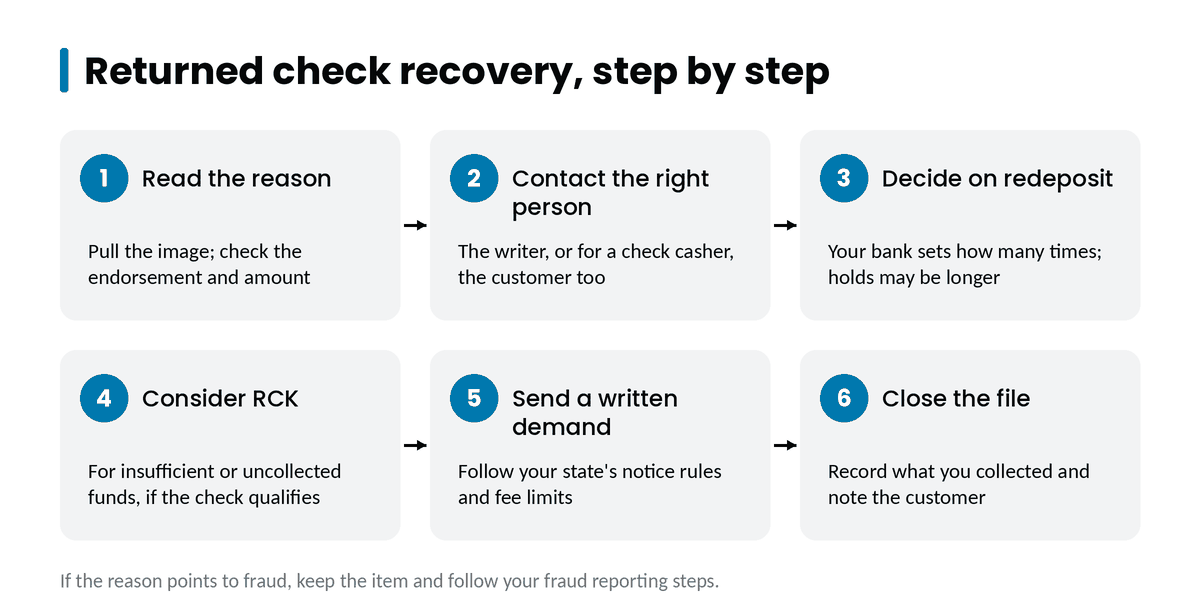
For possible fraud, keep the returned item and your records, and report it under your procedures.
Federal suspicious activity report (SAR) rules don’t require check cashers to file for check cashing alone, though they may file voluntarily. A business that also sells money orders or sends money transfers must file SARs for those transactions (FinCEN). Some states add their own rules; Florida requires licensed check cashers to report suspicious activity to the state (Fla. Stat. 560.309).
Can You Charge a Returned Check Fee?
Yes, within limits your state sets. State law decides how much a payee can charge for a dishonored check, and the rules vary widely.
| State | What a payee can collect |
|---|---|
| Florida | Bank fees it paid, plus a service charge of $25 (checks up to $50), $30 (over $50 to $300), or $40 (over $300), or 5% of the face value, whichever is greater (Fla. Stat. 68.065) |
| Virginia | In a claim on the check: its bank’s return fee, a $50 processing charge, interest, and attorney’s fees if a court awards them (Va. Code 8.01-27.1) |
| Washington | A reasonable handling fee; after notice and 15 days unpaid, 12% interest and collection costs of up to $40 or the check amount, whichever is less (RCW 62A.3-515) |
Check cashers may face added limits. In Florida, a licensed check casher can’t charge collection costs, other than insufficient funds fees the law allows, without a court judgment (Fla. Stat. 560.309).
Collecting the fee electronically needs the consumer’s authorization. Under Regulation E, a posted notice that states the fee, followed by the consumer going ahead with the payment, counts as authorization (12 CFR 1005.3).
What Is Electronic Re-Presentment (RCK)?
A Re-presented Check Entry (RCK) is an ACH debit that collects a paper check returned for insufficient or uncollected funds. It travels through the automated clearing house (ACH) Network in place of redepositing the paper check. Regulation E doesn’t cover it, because the payment started as a check (12 CFR 1005.3).
Three rules shape how it works:
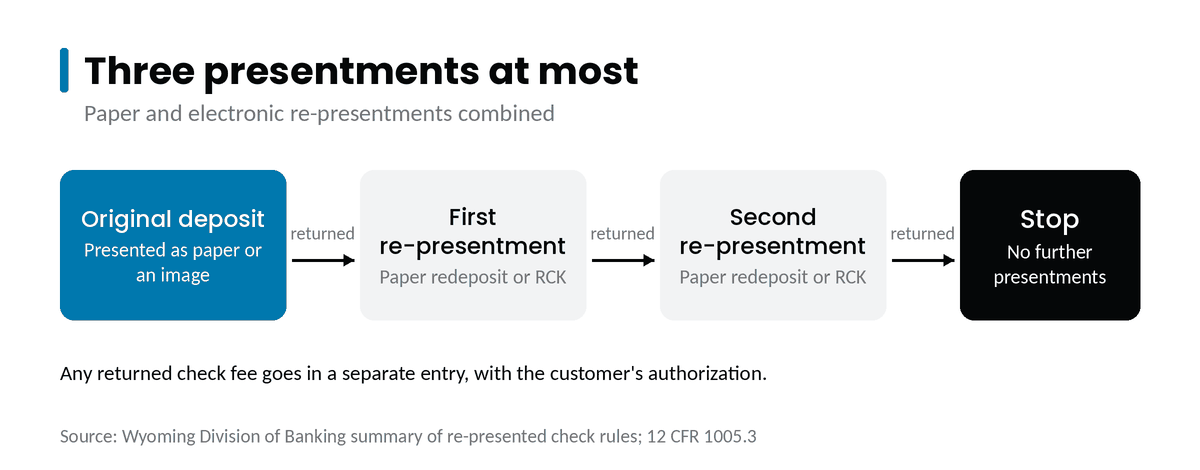
- Three presentments at most. A dishonored check can be presented no more than three times in total, by paper and electronically combined (Wyoming Division of Banking).
- Face amount only. The RCK entry collects the check amount. Any returned check fee must be a separate entry, with the authorization described above.
- Narrow eligibility. Nacha’s rules limit which checks qualify, including limits on the check’s amount and age. Your processor or bank can confirm whether a check qualifies.
If you cash checks for customers, ask your processor or bank whether RCK can collect a check made out to a customer.
How Can You Reduce Returned Checks?
Fewer returns start before you accept the check. Verify identity and endorsements, set limits for first-time customers, and watch for patterns in the checks that come back.
Check fraud is a real driver. FinCEN received 15,417 reports of check fraud tied to mail theft, involving more than $688 million in transactions, in six months of 2023 (FinCEN). Our post on combating check fraud covers prevention controls.
If you deposit checks by scanner, our remote deposit capture checklist explains how to avoid duplicate deposits, one common cause of returns. For returned ACH payments, which follow different rules, see our guide to ACH return codes.
What to Do Next
- Write a returned check procedure that covers each step above, and who owns it.
- Look up your state’s dishonored check law for notice rules and fee limits.
- Post a returned check fee notice where customers pay, if you plan to collect a fee electronically.
- Ask your processor or bank whether RCK is available to you and which checks qualify.
- Track returns by reason each month, and by customer, to spot patterns early.
- Review your fraud reporting steps, including any state reporting rules for your license.
How ReliaFund Helps
ReliaFund’s check processing for money services businesses (MSBs) includes remote deposit capture, with fewer trips to the bank. You get access to 2 years of check images for retrieving checks, and integration with check cashing software.
Compliance support is built into our MSB offering. MSB pros on staff help you maintain regulatory compliance, and we send alerts on compliance updates and trends. We’re a member of the Third Party Payment Processors Association (TPPPA).
Talk to an expert. Call 1-866-243-5040.
Frequently Asked Questions
How many times can a returned check be re-presented? No federal law sets a number for paper redeposits; your bank’s policy does. With electronic re-presentment, a check can be presented no more than three times in total, paper and electronic combined.
What is an RCK entry? It’s an ACH debit that collects a paper check returned for insufficient or uncollected funds. It collects the check amount only; any fee must be a separate, authorized entry.
Can I charge a returned check fee? In most cases, yes, within the limits your state sets. Florida, Virginia, and Washington each set different amounts and conditions.
How soon will my bank tell me a check was returned? Your bank must notify you by midnight of the banking day after it receives the return, or within a longer reasonable time.
Does a check casher have to file a SAR for a bad check? Federal SAR rules don’t require check cashers to file for check cashing alone, though they may file voluntarily. State rules, such as Florida’s, may require reports.
This article is general information. It isn’t legal or compliance advice. Confirm your obligations with your bank and legal counsel.
Sources
- Federal Reserve: Commercial checks returned through the Federal Reserve (updated February 26, 2026)
- Regulation CC: 12 CFR 229.31, 229.33, and 229.13
- Regulation E: 12 CFR 1005.3 and its official interpretations
- OCC HelpWithMyBank: returned third-party checks and resubmitted checks
- FinCEN: MSBs subject to the SAR requirement and check fraud related to mail theft (September 9, 2024)
- State law: Fla. Stat. 68.065, Fla. Stat. 560.309, Va. Code 8.01-27.1, and RCW 62A.3-515
- Wyoming Division of Banking: Represented checks