
Most automated clearing house (ACH) transfers settle in one business day, and that’s the short answer to how long does an ACH transfer take. Same Day ACH payments settle the same business day when they reach the network before a cutoff. Nacha estimates that about 80% of ACH volume settles in one banking day or less (Nacha, August 2023).
Since September 18, 2026, the recipient’s bank must also make next-day ACH credits available by 9 a.m. local time on the settlement date. Four things change the answer: when you submit, credit or debit, Same Day ACH or not, and weekends or holidays. This guide covers each one, with the cutoff times and rules to plan around.
How Long Does an ACH Transfer Take?
An ACH transfer usually takes one to two business days from submission to settlement. Same Day ACH shortens that to a few hours. After settlement, a separate return window decides when a payment you collected is truly final.
Every ACH payment moves through the same six steps:
- You submit the payment. Your business, the Originator, sends payment instructions to your processor or to your bank, the Originating Depository Financial Institution (ODFI).
- Your bank sends it to an ACH Operator. The ODFI batches entries and sends them to the Federal Reserve’s FedACH or to The Clearing House’s Electronic Payments Network (EPN).
- The operator delivers it. The operator sorts the entries and delivers them to each Receiving Depository Financial Institution (RDFI), which is the recipient’s bank.
- The payment settles. On the settlement date, the banks exchange funds for the entry.
- The funds become available. The RDFI makes a credit available to the recipient under Nacha’s funds-availability rules.
- The return window runs. The RDFI can still return the entry for set reasons, most of them within two banking days after settlement.
Credits and debits follow different dating limits. Under the ACH rules, a credit can be dated up to two banking days ahead, but a debit only one (Federal Reserve). That is why you can send payroll two days early. A debit you collect settles no sooner than the next banking day, unless you send it as Same Day ACH.
| Payment type | When it settles | When the money is usable |
|---|---|---|
| Same Day ACH credit | Same banking day: 1 p.m., 5 p.m., or 6 p.m. ET, depending on the window | By 1:30 p.m., by 5 p.m., or by the end of the processing day, in the receiving bank’s local time |
| Next-day ACH credit, such as payroll or a vendor payment | 8:30 a.m. ET on the settlement date, one or two banking days after you submit | By 9 a.m. local time on the settlement date |
| ACH debit, such as collecting an invoice or tuition | The next banking day, or the same day if sent as Same Day ACH | When your processor releases the funds under your agreement; most returns arrive within two banking days |
What Are ACH Cutoff Times?
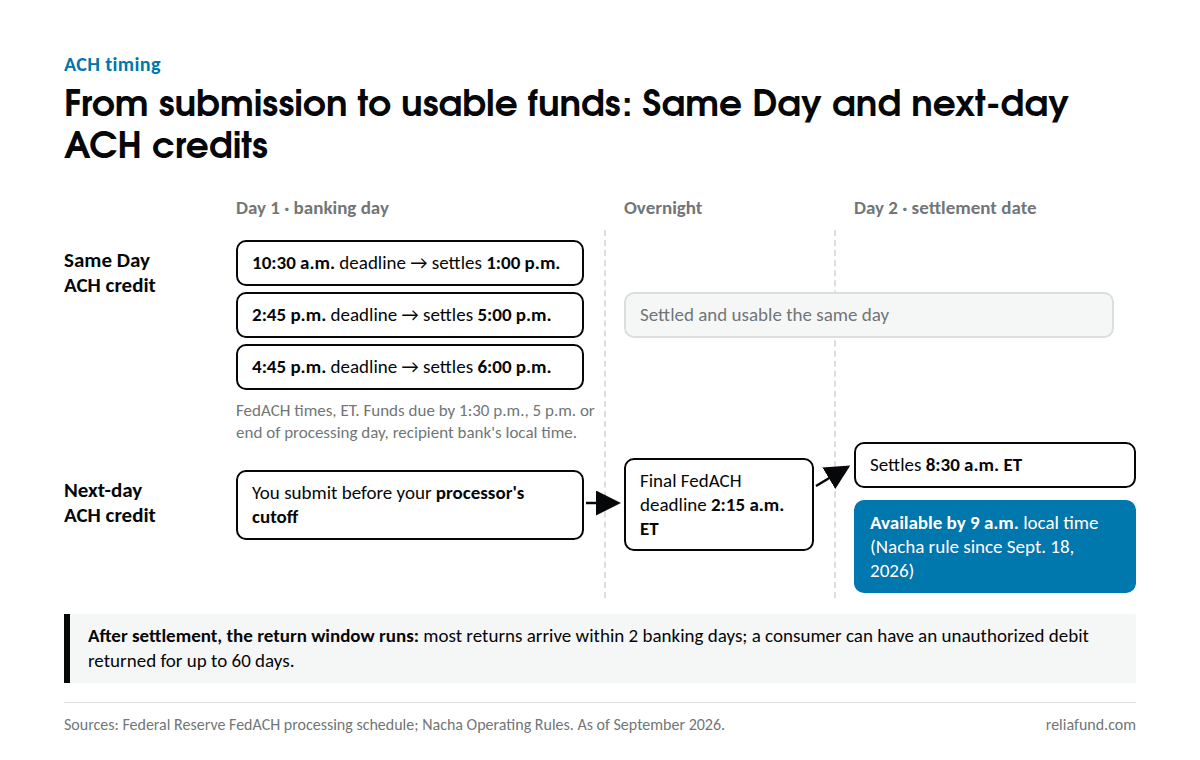
ACH cutoff times are the deadlines a file must meet to settle at a given time. The Federal Reserve’s FedACH service runs three Same Day ACH windows and a series of deadlines for next-day payments (FedACH processing schedule).
| FedACH deadline (ET) | Central time | Settlement | Payment type |
|---|---|---|---|
| 10:30 a.m. | 9:30 a.m. | 1:00 p.m. ET, same day | Same Day ACH, window 1 |
| 2:45 p.m. | 1:45 p.m. | 5:00 p.m. ET, same day | Same Day ACH, window 2 |
| 4:45 p.m. | 3:45 p.m. | 6:00 p.m. ET, same day | Same Day ACH, window 3 |
| 2:15 a.m. (final next-day deadline) | 1:15 a.m. | 8:30 a.m. ET on the settlement date | Next-day and future-dated ACH |
These are the network’s deadlines. Your processor needs time to receive, check, and forward your file, so its cutoffs come earlier. Ask your processor for its cutoff times in writing, and build them into your payment calendar.
Same Day ACH has its own limits. Each payment can be up to $1 million today, and Nacha raises the limit to $10 million per payment on September 17, 2027 (Nacha). International ACH Transactions (IAT) aren’t eligible.
Use is growing. Same Day ACH payments rose 29.5% from a year earlier, reaching 435.7 million payments worth $1.3 trillion in the second quarter of 2026 (Nacha, July 2026). For a payment above the limit that must arrive today, compare the options in ACH vs. wire transfer for businesses.
When Are ACH Credits Available Under Nacha’s 2026 Rule?
Since September 18, 2026, the recipient’s bank must make a next-day ACH credit available by 9 a.m. local time on the settlement date (Nacha). The deadline applies no matter when the operator delivered the entry, including files delivered at 6 a.m. ET that morning.
Before the change, the 9 a.m. deadline applied only to credits the bank received by 5 p.m. local time the prior banking day. Credits that arrived later only had to be available by the end of the settlement date (Nacha, 2019 rule). The new rule removes that condition for all credits that aren’t Same Day ACH (Nacha, September 2026).
Three details matter for planning:
- 9 a.m. is the latest time allowed. Banks may make funds available earlier, and many already do.
- Settlement doesn’t move. The rule changes when the recipient can use the money. The settlement time stays the same.
- Same Day ACH timing is unchanged. Credits from the three windows remain due by 1:30 p.m., by 5 p.m., and by the end of the processing day, local time (Nacha).
For employers, this makes payday more predictable. If payroll settles on payday, your employees’ banks generally must make their pay available by 9 a.m. that morning. The main exception is a credit a bank suspects is fraudulent. For vendors you pay by ACH, it means fewer “why isn’t it there yet?” calls.
What’s the Difference Between Settlement and Funds Availability?
Settlement is when the banks exchange funds for an ACH entry. Funds availability is when the recipient can actually use the money. The return window is separate from both, and it’s the reason a settled debit isn’t always final.
This explains a common question: why does a payment you collected show as settled but not yet usable in your operating account? When you debit a customer, the funds settle on the settlement date. But the customer’s bank can still return the debit, and your processor carries that risk until the window closes.
Under the Nacha Operating Rules, return windows depend on the reason for the return:
- Most returns, such as R01 (insufficient funds) and R03 (no account), are due by the opening of business two banking days after settlement.
- Unauthorized consumer debits can be returned for up to 60 days, under codes such as R10 and R11 (Nacha).
- Unauthorized business debits come back as R29, within the two-banking-day window.
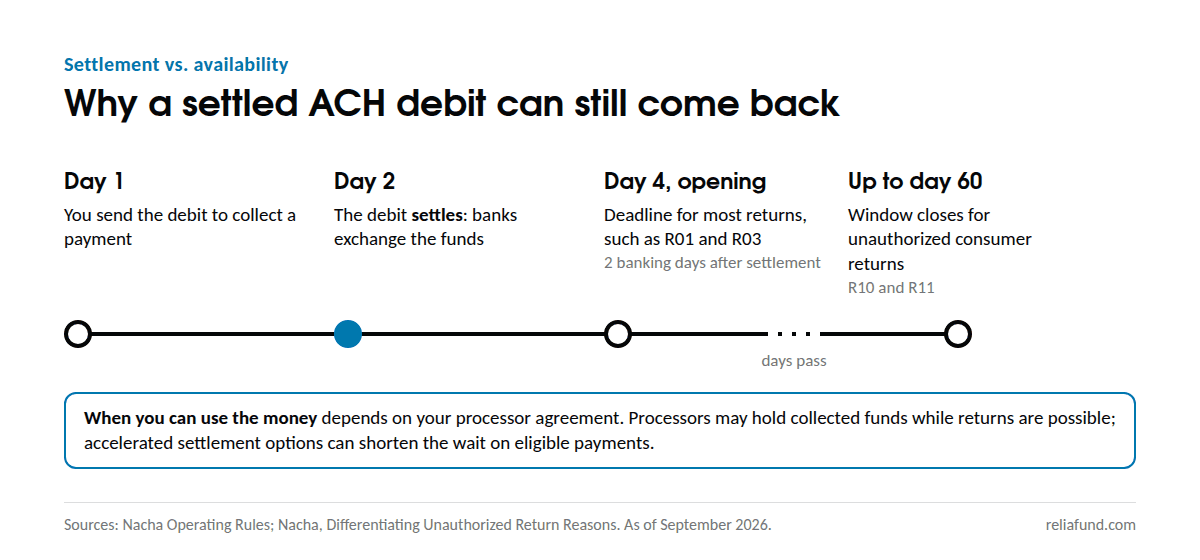
That is why processors may hold collected funds for a period before releasing them, based on your history and risk. A reliable way to shorten the wait is to keep returns low. Validate new accounts and keep clean authorizations.
Watch your debit return rates against Nacha’s thresholds: 0.5% unauthorized, plus inquiry levels of 3% administrative and 15% overall (Nacha). Our guide to ACH return codes explains each code and what to do next.
Does ACH Process on Weekends and Holidays?
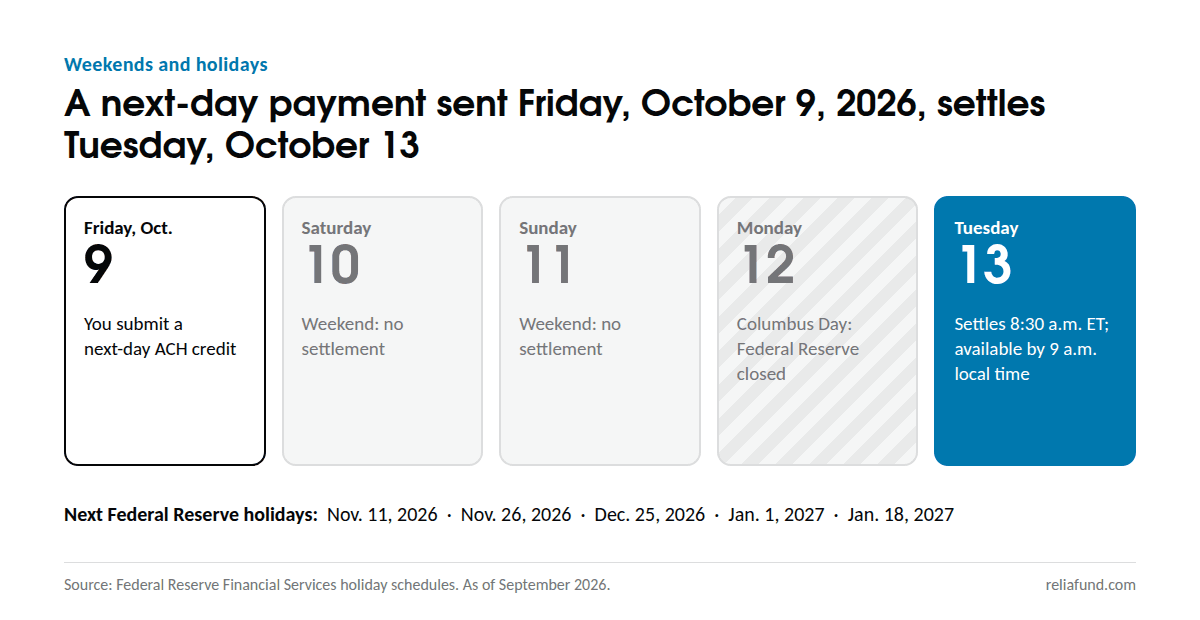
No. ACH payments settle only on banking days, so nothing settles on Saturdays, Sundays, or Federal Reserve holidays. A payment dated for a non-banking day settles on the next banking day (Federal Reserve Operating Circular 4). You can still submit files on a weekend; they wait for the next banking day.
In October 2025, the Federal Reserve announced Sunday and weekday-holiday operations for its Fedwire Funds and National Settlement services, starting no earlier than 2028. The announcement doesn’t include FedACH (Federal Reserve).
These are the next Federal Reserve holidays (Federal Reserve):
- Veterans Day: Wednesday, November 11, 2026
- Thanksgiving Day: Thursday, November 26, 2026
- Christmas Day: Friday, December 25, 2026
- New Year’s Day: Friday, January 1, 2027
- Martin Luther King Jr. Day: Monday, January 18, 2027
Holidays next to a weekend create longer gaps. A next-day payment sent Friday, October 9, 2026, settles Tuesday, October 13, because of the weekend and Columbus Day. When payday falls on a weekend or holiday, many employers pay on the banking day before.
What to Do Next
Use this checklist to get payments where they need to be, on time:
- Get your processor’s cutoff times in writing, for next-day and Same Day files, and post them where your team schedules payments.
- Date payroll and vendor credits for the day the money is due. Under the 9 a.m. rule, a credit that settles on payday is usable that morning.
- Collect early enough to cover the return window. If you need collected funds by a date, send the debit at least three banking days before it.
- Use Same Day ACH for urgent payments, where your processor offers it, and stay under the $1 million per-payment limit.
- Mark the Federal Reserve holidays on your payment calendar through January 2027.
- Validate new bank accounts before the first debit. Administrative returns such as R03 cost you days and count toward Nacha’s 3% level. Our tips on reducing ACH payment failures show how.
- Review returns monthly by type as well as in total, so you can see what is slowing your cash.
How ReliaFund Helps
ReliaFund has processed payments since 2001, and ACH processing is our primary focus. Our platform is built in-house and offers accelerated settlement options. Reporting goes down to the transaction level and shows each ACH payment’s status from pending to funded to settled.
When you call 1-866-243-5040, a team member answers and directs your call. We’re a member of the Third Party Payment Processors Association (TPPPA), and we offer a 30-day account with no long-term contracts.
Frequently Asked Questions
Is ACH instant? No. ACH payments move in batches and settle at set times on banking days. Same Day ACH settles within a few hours of each window’s deadline.
How long does an ACH debit take to clear? An ACH debit settles on the next banking day, or the same day as Same Day ACH. Most returns arrive within two banking days after settlement. A consumer can have an unauthorized debit returned for up to 60 days.
Why is my ACH deposit still pending? The usual causes are a submission after the cutoff, a weekend or holiday, or a future settlement date. For payments you collected, your processor may also be holding funds while the return window runs.
Can I send an ACH payment on a Saturday? You can submit it, but it won’t settle until the next banking day. That is usually Monday, or Tuesday when Monday is a Federal Reserve holiday.
What is the Same Day ACH limit? $1 million per payment. Nacha raises the limit to $10 million per payment on September 17, 2027.
This article is general information. It isn’t legal or compliance advice. Confirm your obligations with your bank and legal counsel.
Sources
- Nacha: Funds Availability Requirements for Non-Same Day ACH Credit Entries and New funds availability requirements take effect Sept. 18 (September 1, 2026)
- Nacha: A significant majority of ACH payments settle in one business day or less (August 28, 2023)
- Nacha: Increasing the Same Day ACH dollar limit to $10 million
- Nacha: ACH Network volume, second quarter 2026 (July 2026)
- Nacha: Differentiating Unauthorized Return Reasons and ACH Network Risk and Enforcement Topics
- Federal Reserve Financial Services: FedACH processing schedule, Same Day ACH FAQ, holiday schedules, and Operating Circular 4
- Federal Reserve Board: Expanded operating days announcement (October 9, 2025)